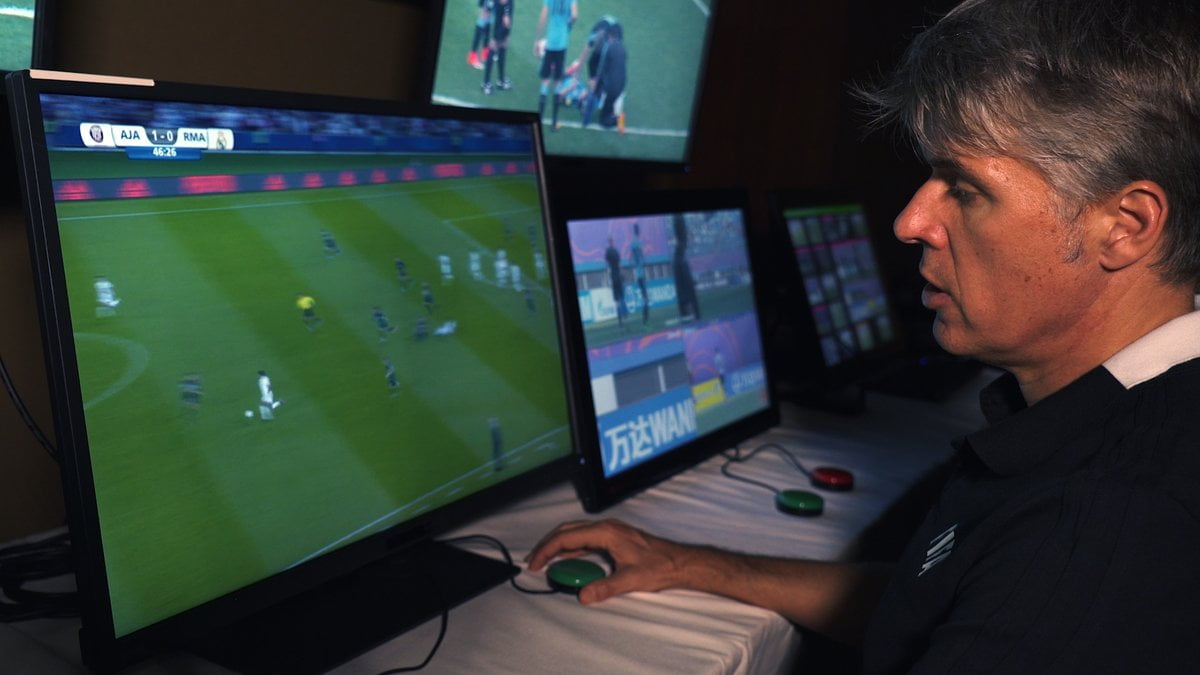
Four years ago FIFA introduced goal-line technology to the World Cup in Brazil and now the 2018 World Cup in Russia is set to make it’s own little bit of history thanks to the introduction of VAR (Video Assistant Referees) at the tournament.
Given the global stage of the competition, this is a significant step forward in terms of using technology to assist the match referee and we all can think of past situations where some on-field decisions have been pretty questionable.
No matter how well they are trained and how experienced they might be, sometimes referees fail to notice what happens on the field. Sometimes, they miss fouls, offsides, and sometimes, even the position of the ball on the goal line can be questionable.
Football has, in turn, reached out to a trending piece of techology to help the sport avoid any ambiguity during matches. This is why VAR, video assistant referee was created.
What is VAR
The VAR, or “video assistant referee”, is an assistant referee who reviews the decisions made by the head referee using video footage shot during the game and communicates his findings using a headset.
The VAR can currently review four types of decisions made: goals (and the potential violations of the actions leading to it), red card decisions, penalty decisions, and the potentially mistaken identity when awarding red and yellow cards.
FIFA VAR expert and former FIFA Elite Referee, Roberto Rosetti explains the four match-changing situations that VAR can be used for during a match: https://t.co/bfkRCVgHiV https://t.co/onUHYpNc9G #FootballTechnology pic.twitter.com/cgJIYGi86P
— FIFA Media (@fifamedia) April 24, 2018
The first live trial of the VAR system started in August 2016 during a match between two Major League Soccer reserve sides, followed by deployment during a friendly match between France and Italy one month later.
In 2016, FIFA implemented a “pitchside monitor” during the Club World Cup where referees could review footage recorded during the game and in April 2017, Australia’s A-League started using VAR during its matches, followed by the US’s Major League Soccer, and most top-tier leagues in Europe.
VAR was used in the FA Cup competition last season for selected matches, including several Swansea City games, but there appears to be some reluctance to use it in the Premier League at the moment.

Is it useful?
The VAR system has received its share of both praise and criticism. But is it useful? Let’s see an example of an actual match.
On April 16, Mainz were playing fellow German Bundesliga side Freiburg. At the end of the first half-time, the players of both teams were returning to their respective locker rooms when referee Guido Winkmann was informed that he missed a foul committed by one of Freiburg’s players, Marc-Oliver Kempf – he touched the ball with his hands inside the penalty area. Thus, a penalty was due.
The referee corrected the omission on the spot: he called both teams back into the field, where the penalty was scored by Mainz player Pablo de Blasis, after which the players could return to their lockers to continue their break.
The second half-time started 10 minutes late, and ended with de Blasis scoring once again, allowing Mainz to stay in the Bundesliga and knock out Freiburg by goal difference.
In a situation such as this, the VAR system can be useful, if a little controversial.
VAR isn’t without its critics however, as the Spurs v Rochdale FA Cup replay proved last season proved, with several players labelling it ‘Comical’ and ’embarrassing’ in light of the confusion caused by a goal being disallowed and a penalty overturned during a manic first 45 minutes for referee Paul Tierney.
Its use is now sanctioned in the Laws of the Game on a permanent basis but remain optional for the Premier League and the UEFA Champions League, for the time being at least. UEFA have already said that VAR will not be used in the Champions League for the 2018/19 season.
The limited use of the technology in the British game, seems to be reflected in FIFA’s choice of VAR officials for the 2018 World Cup, with no British officials appointed whatsoever. They have opted for the follow instead;
- Mauro Vigliano (Argentina)
- Gery Vargas (Bolivia)
- Wilton Sampaio (Brazil)
- Bastian Dankert and Felix Zwayer (Germany)
- Danny Makkelie (Holland)
- Daniele Orsato, Paolo Valeri and Massimiliano Irrati (Italy)
- Pawel Gil (Poland)
- Artur Soares Dias and Tiago Martins (Portugal)
- Abdulrahman Al Jassim (Qatar)
There is no doubt that the technology will become part and parcel of the beautiful game in all leagues and cup competitions around the world eventually, but at the moment its usage is still in its early stages, and with the eyes of the world soon to be watching, the success (or failure) of its use during the World Cup could determine how quickly or not things progress.